VORT Manoeuvre Guide

Angle Park in South Australia

Angle park, also called a 90-degree angle park front to kerb, is one of the five slow speed manoeuvres used in South Australian VORT preparation. It tests whether you can select a suitable parking bay, signal correctly, observe properly, control the vehicle and park wholly within the bay.

This guide explains the manoeuvre in plain English for learner drivers and overseas licence holders in Adelaide. It is a training guide only and does not replace official South Australian road rules.

What Is an Angle Park?

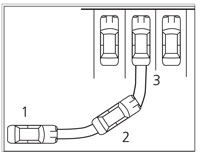
An angle park requires the driver to enter a parking bay front first, normally at about 90 degrees to the kerb or end of the bay. In the South Australian Driving Companion, the task is described as a 90-degree angle park, front to kerb.

Goal 1

Enter in one attempt

The vehicle should enter the bay under control without reversing to adjust after entering.

Goal 2

Stay within the bay

The car should finish wholly within the parking bay, reasonably straight and not too far from the kerb or end line.

Goal 3

Leave safely

Reversing out safely requires strong observation, slow control and awareness of the front of the vehicle.

Simple version: choose the bay, mirror, signal, slow down, check the inside of the turn, enter smoothly in one attempt, then reverse out slowly with full observation.

Before You Enter the Bay

The angle park is not only about steering. The test standard also checks signal timing, mirror use, observation and vehicle clearance before the steering starts.

Good

Suitable parking bay

  • Large enough and clearly marked
  • No pedestrians, cyclists or obstacles in or near the bay
  • No vehicle reversing or moving near the parking area
  • Enough approach distance to slow and turn smoothly
  • Enough clearance from vehicles beside the bay
Avoid

High-risk approach

  • Signalling too late or after slowing suddenly
  • Turning before checking inside clearance
  • Entering too fast
  • Cutting across a bay where another road user may be moving
  • Relying only on a reference point and ignoring surroundings
Training tip: in a car park, pedestrians and vehicles can appear from unexpected directions. Look around before you steer, not only after the car starts turning.

Step-by-Step: Entering an Angle Park

There is no single magic reference point that works for every car and every bay. The following is a safe learning sequence. Your instructor may adjust reference points depending on the vehicle, bay size and road layout.

Select a suitable parking bay

Choose a bay that is safe, legal and practical. Check for pedestrians, cyclists, shopping trolleys, parked cars and vehicles moving nearby.

Check mirrors, signal and slow down

Check the centre mirror and the side mirror on the side you will turn toward. Signal clearly, then slow to a safe and controllable speed.

Choose the correct gear and speed

In an automatic, keep the vehicle slow and controlled. In a manual, choose a gear that gives smooth control.

Check inside clearance before steering

Before turning the steering wheel into the bay, check the inside of the turn. This may be a mirror check or shoulder check, depending on the situation.

Turn into the bay smoothly

Steer into the bay at slow speed. Keep checking the front corners, side clearance and the lines of the bay.

Finish wholly within the bay

Stop with the vehicle front to kerb or end of bay, without touching the kerb. Where practical, the car should be central in the bay and the front wheels should point straight ahead.

Secure the vehicle

Stop safely and secure the vehicle as required. In a test situation, listen carefully for the examiner’s next instruction.

Position Standard

The final position matters. A vehicle that is inside the bay but very crooked, too far forward, or touching the kerb may not meet the required standard.

Requirement Plain English meaning Training focus
Wholly within the bay The vehicle should not be over the parking bay lines. Approach slowly and line up early.
Not more than 300 mm out of parallel with the lines The car should not be badly angled or crooked inside the bay. Correct steering timing and finish with wheels straight where practical.
Not more than 300 mm from kerb or end of bay The car should not stop too far away from the front of the bay. Use slow speed and stop accurately before touching the kerb.
Do not touch the kerb The front of the car or wheels should not hit the kerb. Control speed and brake gently before the kerb.
Key reminder: the aim is not to park quickly. The aim is to park accurately and safely under full control.

Step-by-Step: Leaving the Angle Park

Leaving the parking bay is often harder than entering because the car is reversing and the front of the vehicle may swing close to vehicles or obstacles beside the bay.

Select reverse gear

Prepare the car and select reverse. Keep the vehicle slow and controlled.

Check all around before moving

Check behind over your shoulders, both sides and to the front before moving. Do not rely only on mirrors or the reverse camera.

Reverse slowly

Reverse only as far as needed. Keep checking behind, both sides and the front corner clearance.

Clear the vehicle beside you

Watch the front of your car carefully as it swings out. Avoid nearby cars, kerbs, posts, trolleys or pedestrians.

Prepare to move forward safely

Counter-steer enough to prepare the vehicle to move off safely down the road or lane. Avoid unnecessary reversing.

Move off safely

Select Drive or first gear, check mirrors and relevant traffic, signal if appropriate, then move off safely without rolling.

Observation reminder: when reversing out of a bay, keep your eyes moving. Check behind, sides and front repeatedly because people and cars can appear while you are already moving.

Common Mistakes in Angle Parking

Signal after braking or steering

The signal should come before the driver slows or steers into the bay, so other road users can understand the intention.

No inside clearance check

Before steering into the bay, check the side you are turning toward for pedestrians, cyclists, vehicles or obstacles.

Entering too fast

Too much speed makes it harder to steer, stop accurately and avoid touching the kerb.

Reversing to fix the entry

The angle park should be completed front to kerb on the first attempt.

Stopping too far from the kerb

The vehicle needs to finish close enough to the kerb or end of bay without touching it.

Weak observation when reversing out

Looking only at the camera or only behind is not enough. Both sides and the front must also be checked.

What Can Cause a “Not Yet Competent” Result?

In a test or assessment situation, angle park may be marked as not yet competent if the driver does not complete the manoeuvre safely, accurately and in sequence.

High-risk problems

  • Not checking mirrors or signalling before slowing and turning.
  • Failing to check the inside of the turn before steering.
  • Touching the kerb while entering.
  • Not positioning the vehicle wholly within the bay.
  • Stopping too far from the kerb or end of the bay.
  • Reversing after entering to adjust the parking position.
  • Not checking properly before or during reversing out.
  • Hitting or nearly hitting another car, kerb, pole, pedestrian or obstacle.
  • Performing the steps out of sequence.

Instructor Tips

Tip

Signal before the action

If the signal starts after the car has already slowed or turned, other road users do not get enough warning.

Tip

Do not trust only reference points

A reference point may help, but the driver must still check traffic, pedestrians, lines, kerb and vehicle clearance.

Tip

Use slow speed

Slow speed gives you time to steer accurately and stop before touching the kerb.

Tip

Watch the front when reversing out

Many students look behind but forget the front corner of the car swings close to the next bay or vehicle.

How This Connects to VORT Preparation

Angle park is part of the five slow speed manoeuvres in the VORT. It shows whether the driver can combine signal timing, observation, judgement, low-speed control and accurate vehicle positioning.

Observation

Mirror checks, inside clearance checks and all-around checks when reversing.

Control

Smooth speed, steering and braking while entering and leaving the bay.

Accuracy

Wholly within the bay, close enough to the kerb or end, and reasonably parallel with the bay lines.

To prepare properly, practise with a driving instructor first. Car parks can be unpredictable, so do not practise in busy shopping areas until you can complete the manoeuvre safely.

Other VORT Manoeuvre Guides

Angle park is one of the five slow speed manoeuvres. You can also read the other manoeuvre guides when they are available.

Moving off from kerb

Guide coming soon

Reverse parallel park

Read guide

Three-point turn

Read guide

U-turn

Read guide

All insights

View Insights

VORT overview

Read VORT guide

Official Reference

Use official sources for licensing and assessment information because requirements may change.

Scroll to Top