VORT Manoeuvre Guide
Angle Park in South Australia
Angle parking tests approach position, signalling, observation, low-speed control and accurate placement inside the bay.
Reversing out safely is equally important. Keep checking behind, both sides and the front corners of the vehicle.
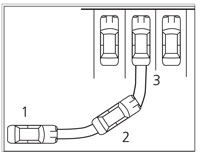
What the manoeuvre assesses
Approach
Choose a suitable bay, check mirrors, signal early and slow down before turning.
Position
Finish wholly inside the bay, reasonably straight and close enough to the kerb or end line without touching it.
Reversing out
Give way, reverse slowly and watch the front corners as the vehicle swings out.
Simple version: select the bay, mirror, signal, slow down, check inside clearance, enter smoothly, then reverse out with full observation.
Entering the angle park
- Select a safe, legal and clearly marked bay.
- Check the centre mirror and the side mirror on the turning side.
- Signal clearly and reduce speed before steering.
- Check pedestrians, cyclists, vehicles and inside clearance.
- Turn into the bay at very low speed.
- Monitor both bay lines and the front-corner clearance.
- Gradually straighten the steering.
- Stop wholly inside the bay without touching the kerb.
Training tip: reference points vary between vehicles. Observation and low-speed control matter more than one fixed landmark.
Reversing out safely
- Select reverse and check all around before moving.
- Look directly behind and to both sides; cameras and sensors are only aids.
- Give way to pedestrians, cyclists and vehicles in the aisle.
- Reverse slowly with the wheels initially close to straight.
- Watch the front corners as they clear adjacent vehicles.
- Turn only when there is enough clearance.
- Stop in a suitable position, observe again and move forward safely.
Common mistakes
- Signalling after braking or steering has already started.
- No inside-clearance check before turning.
- Entering too quickly.
- Parking over a line or too far from the end of the bay.
- Touching the kerb.
- Reversing to correct the entry position.
- Looking only at the reverse camera when leaving.
- Forgetting the front of the vehicle swings toward nearby cars.