南澳 VORT / CBT&A 五个低速动作说明
注意:在路考违反交通法,将会马上终止路考。建议不要只集中在顺序和步骤上。An immediate fail will be recorded if the applicant fails to comply with Australian Road Rules.
这5个动作占了路考的10%。在南澳路考系统中,指令动作不是强制性的。考生不一定要做对,做错只是扣分。每个成功的动作有2分,但顺序或动作做错都是扣2分。
Moving off from kerb 起步动作 (更新至 21-12-2021)
[youtube https://youtu.be/2WWCF47H7M4]
必须把步骤按顺序进行。
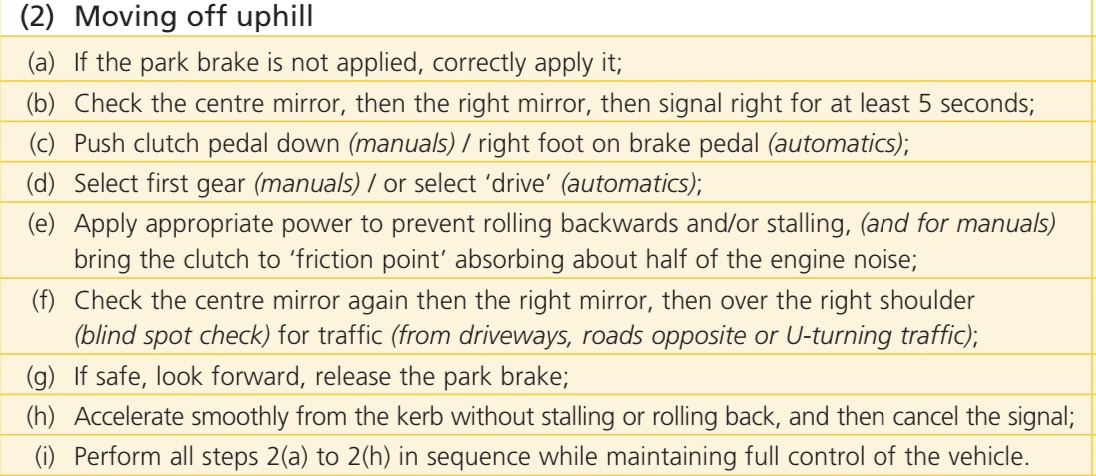
Note: This procedure may change due to manufacturer’s requirements
A reasonable hill for the purpose of this exercise is the one with a gradient sufficient enough to create a likelihood of the vehicle rolling backwards. The automatic hill holder must be switched off. If, due to vehicle design, it is not possible to switch off the automatic hill-holder, the gradient must be sufficient enough to cause the automatic hill-holder to activate. A verbal explanation must also be provided covering the operation of a vehicle that is not fitted with an automatic hill holder as outlined above.
在进行此动作前,考官会在足够的时间内提供指令让学生自行选择位置靠边停车。详情可以看以下连结:靠边停车。
- 检查一下手刹是否拉紧,如果没有拉手刹,现在可以补上。
- 首先用后视镜,再用右侧镜,來观察后方交通, 打最少五秒转向灯 (右灯, 如果我们停在左面)澳洲交通法ARR46(3)
- 右脚踩刹车板。
- 换挡(换波)至 D(Drive)。
- 如果是上坡路,放开刹车板, 并移到油门(加速器) 应用适当的动力,防止向后滚动和/或失速。(注意:如果车辆自带上坡辅助系统 Hill-start Assist Control,可以忽略此步,但请确保它正常运作)
- 看后视镜,再用右侧镜,如果镜子里没车, 看右盲点。让路距离将会和你的能力和信心有关。很大可能要10至15秒车距才能够做。澳洲交通法ARR87
- 如果没车, 眼望前方, 然后放开手刹。(注意:如果手剎会自动取消可以忽略此步)
- 往前加速,然后取消灯号。
- 必须把步骤1至8按顺序进行。
原文:http://mylicence.sa.gov.au/the-driving-companion/u1t3
原文:http://mylicence.sa.gov.au/the-driving-companion/u2t9
Angle park 进出库动作
驶入出停车位没有固定方法,但必须按照以下要求。
- 在减速和动方向盘之前必须已经打信号灯。
- 进入车位时必须一口气驶入,不可往后退。
- 在动方向盘之前必须要看同方向的盲区。
以下是其中一种方法。
[youtube https://youtu.be/1BuxrcbyEXE]
驶入停车位(头入)
- 选择一个适合的停车位(例如右边的车位),确定之后看后视镜,看右侧镜,打右转向灯,减速。
- 除了看对面的交通,同时,观察和停车位同方向的位置是否有其它道路使用者,例如:在停车位边上的行人,自行车,及后方是否有车辆在你需要转的方向超车。
- 如果是停右边车位的话,从司机角度右侧镜的底线与想要进入的车位重叠时,就可以开始右满舵。(注意:老司机可以用自己的方法。)
- 进入了车位之后,车头不可以过路牙,也不可以与路牙超过30厘米。同时,车身需要与车位水平,不可以有超过30厘米误差。
- 进入车位时需要一步到位不可以换后档重新调整。
驶出停车位(尾出)
- 入后挡。
- 在往后移动之前及其间,保持看右看前看左看后。观察来往的道路使用者。
- 在往后的同时,多注意车身前方的障碍物,例如:停在旁边的车辆,购物车,垃圾桶 etc.
- 如果前方有足够位置,不要做多余的后退。并且根据前方的空间,开始回正方向盘或反方向打满方向盘。
同時,不能夠原地打方向dry steering。 - 看后视镜, 脚踩刹车板, 换挡(换波)至 D(Drive)
- 看后视镜,看右边和左边的道路使用者。
- 换了前进挡之后,除了回轮之外,方向盘不可以多转超过一圈。
原文:http://mylicence.sa.gov.au/the-driving-companion/u2t12
Reverse parallel park 侧方停车
详情可以看以下连结.
3-point Turn
详情可以看以下连结。
U-Turn
可以看以下连结。
Australian Road Rules reference 澳洲交通法参考资料
Australian Road Rule 38 – Giving way when making a U-turn
A driver making a U-turn must give way to all vehicles and pedestrians.
Offence provision.
Note: For this rule, give way means the driver must slow down and, if necessary stop, to avoid a collision—see the definition in the dictionary.
在进行三点掉头和U字掉头时,必须让路给在路上的所有道路使用者。
Australian Road Rule 46(3)
If the driver is about to change direction by moving from a stationary position at the side of the road or in a median strip parking area, the driver must give the change of direction signal for at least 5 seconds before the driver changes direction.
在路旁离开进入行车线前,在移动前必须已经有5秒灯号。
Australian Road Rules 87 – Giving way when moving from a side of a road or a median strip parking area
(1) A driver entering a marked lane, or a line of traffic, from the far left or right side of a road must give way to any vehicle travelling in the lane or line of traffic.
Offence provision.
Note 1: Line of traffic and marked lane are defined in the dictionary. Note 2—
For subrule (1), give way means:
(a) if the driver is stopped—remain stationary until it is safe to proceed; or
(b) in any other case—slow down and, if necessary, stop to avoid a collision,
—see the definition in the dictionary.
在路旁离开进入行车线时,必须让路给同方向的所有道路使用者。
为什么这些动作容易失败?
很多学生不是不会开车,而是不习惯按考试要求完成动作。低速动作真正考的是:
- 顺序
- 观察
- 信号
- 让路
- 速度控制
- 方向盘控制
- 是否影响其他道路使用者
例如,moving off 前要先看 centre mirror 和 right mirror,然后才打右灯。打灯后还要等足够时间,再做 final check。顺序错了,即使车开得出去,也可能会被扣分。
关于 dry steering 原地打方向
目前的 Driver Companion 说明中,dry/stationary steering 并不是直接禁止,但不鼓励。简单来说,考试时最好尽量让车辆轻微移动时转方向盘,而不是长时间原地打满方向。
上课建议
如果你准备参加 Firle VORT 路考,建议先做一次评估课。评估课会检查:
- 你的 observation 是否达标
- signal 和 mirror 顺序是否正确
- 起步和停车是否稳定
- 低速动作是否符合考试要求
- 是否能够在真实道路环境中安全判断
如果你已经有海外驾驶经验,通常不是从零开始学,而是需要把原来的驾驶习惯调整到南澳考试标准。