
School-area speed limits in South Australia do not all work the same way. A lower limit may be activated because children are present, amber lights are flashing, a school bus has stopped to pick up or set down children, or the signed school-day time is active.
Do not rely only on the time, whether you can see a child, or the speed shown by your navigation system. Read the road signs and respond to the conditions that apply at that location.
Four school-related speed rules to remember
- A child is present in a signed school zone: 25 km/h.
- Amber lights are flashing at a children’s crossing: 25 km/h.
- The signed time is active on a school day: 40 km/h.
- You are passing a school bus stopped to pick up or set down children: 25 km/h.
1. A child is present in a signed school zone
Speed limit: 25 km/h
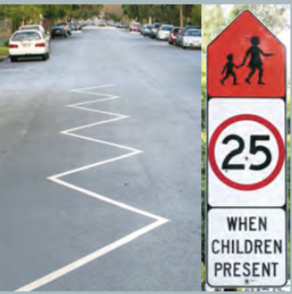
A school zone is the section of road between a School Zone sign and an End School Zone sign. The 25 km/h limit applies when a child is present on the road, footpath, median strip or a bicycle within the school zone.
For this rule, a child is a person under 18 years of age or a student of any age wearing a school uniform. A child may be walking, waiting to cross, riding a bicycle or scooter, standing near the road, or getting into or out of a vehicle.
This rule can apply at any time, including outside normal school hours, on weekends and during school holidays. If a child is present in the signed school zone, the 25 km/h rule may apply.
Remain at 25 km/h or below until you pass the End School Zone sign or another speed-limit sign. Do not accelerate early simply because you have passed the school gate or can no longer see the child.
2. Amber lights are flashing at a children’s crossing
Speed limit: 25 km/h
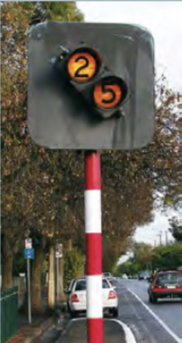
Some children’s crossings have amber lights and a sign stating that the lower limit applies when the lights are flashing. While the amber lights are flashing, the 25 km/h limit is active even if you cannot see a child at that moment.
- Reduce to 25 km/h or below before entering the signed section.
- Be ready to stop for children, other pedestrians and school crossing supervisors.
- Do not ignore the lower limit because the crossing appears empty.
- Keep the lower speed until the end sign or another speed-limit sign.
3. Time-based 40 km/h school speed limits expanded from January 2026
Speed limit: 40 km/h
South Australia is progressively installing time-based 40 km/h speed limits on busy roads near schools, particularly where the normal speed limit is 50 km/h or higher and students regularly cross or travel beside the road.
The first signs began operating in November 2025, with the rollout expanding to more locations from January 2026. Installation across all selected sites is scheduled for completion in late 2026. A site becomes enforceable once its signs have been installed.
The limit does not automatically apply merely because a school is nearby. It applies only where the official signs are installed and the signed school-day time is active.
When does the 40 km/h limit apply?
The time-based 40 km/h limit generally applies on school days during these periods:
- 8:00 am to 9:30 am
- 2:00 pm to 4:00 pm
During those times, the 40 km/h limit applies even if no children are visible. Your vehicle must be at or below 40 km/h when it passes the start sign, and the lower limit continues until the end sign or another speed-limit sign.
What does “school day” mean?
For these signs, a school day is determined using the Department for Education’s South Australian state school term dates. In practical terms, the rule follows the official calendar for South Australian government schools.
This means drivers do not decide whether the limit applies by checking whether the nearby school appears open, whether students are visible, or whether that particular school has its own activity day.
- A normal South Australian state-school weekday during term: a school day.
- Saturday or Sunday: not a school day.
- Public holiday: the time-based limit does not apply.
- South Australian state-school holiday period: the time-based limit does not apply.
Even when a signed 40 km/h section is outside a private or Catholic school, the school-day definition still follows the South Australian state-school calendar rather than the individual school’s calendar.
South Australian state-school term dates for 2026
- Term 1: Tuesday 27 January to Friday 10 April
- Term 2: Monday 27 April to Friday 3 July
- Term 3: Monday 20 July to Friday 25 September
- Term 4: Monday 12 October to Friday 11 December
Weekends and public holidays remain excluded within those date ranges. Term dates change each year, so check the current Department for Education calendar rather than relying on an old list.
Does the 40 km/h limit replace the existing 25 km/h school zone?
No. The time-based 40 km/h limit is an additional safety measure on selected roads. It does not remove the existing 25 km/h school-zone rule.
Near one school, a driver may encounter a time-based 40 km/h section on a main road, a 25 km/h school zone in a side street when a child is present, and a flashing-light children’s crossing. Read each sign and apply the rule for the road section you are entering.
4. Passing a school bus stopped for children
Speed limit: 25 km/h
When a school bus has stopped to pick up or set down children, drivers passing the bus must slow to 25 km/h. Reduce speed early, leave a safe gap and be ready for a child to appear from in front of or behind the bus.
This rule is not limited to the area between School Zone signs. It can apply wherever a school bus is stopped to pick up or drop off children.
What do Children Crossing flags mean?
An emu crossing has red-and-white posts and operates when the Children Crossing flags are displayed. Emu crossings are located within school zones.
- Approach at a speed that allows you to stop safely.
- Give way to pedestrians using or about to use the crossing.
- Stop if a school crossing supervisor displays a Stop sign.
- The crossing protects adult pedestrians as well as children.
The flags are not a separate fourth type of school speed limit. The 25 km/h school-zone rule still depends on a child being present and the signed school-zone boundaries.

Entering, driving through and leaving the lower-speed section
Before the start sign
- Look early for children, flashing lights, time panels and school buses.
- Work out which rule is active.
- Reduce speed smoothly so the vehicle is compliant as it passes the start sign.
While driving through
- Maintain the applicable speed rather than allowing the vehicle to creep faster.
- Scan footpaths, parked vehicles, buses and crossings.
- Expect children to change direction or emerge between vehicles.
At the end
Do not return to the higher speed until you pass the end sign or another speed-limit sign. Passing the school gate, crossing or flashing-light equipment does not necessarily mean the lower limit has ended.
Common learner and VORT mistakes
- Braking after the sign: the lower speed should already have been reached before the vehicle enters the active section.
- Watching only the zigzag lines: the road markings are a warning; the signs determine the limit and its boundaries.
- Ignoring flashing lights because no child is visible: the lights activate the 25 km/h limit.
- Ignoring the time panel: the signed 40 km/h limit applies during the school-day times even when no child is visible.
- Accelerating too early: wait for the end sign or another speed-limit sign.
- Relying on navigation: map and vehicle speed-limit systems may not correctly recognise a new or time-based limit.
School-area rules test more than speed control. They show whether a driver can identify a conditional road rule, interpret signs early and respond before entering a higher-risk area. Breaching an active school speed limit can affect a VORT result.
Official information
- Department for Infrastructure and Transport: 40 km/h school speed limits
- 40 km/h school speed limits: Frequently Asked Questions
- MyLicence: School safety
- The Driver’s Handbook: Speed limits
- Department for Education: South Australian state-school term dates
This article is for general road-safety education. It does not replace current South Australian road rules or signs. Rules, term dates and rollout locations may change, so check current government information.
Preparing for a South Australian driving test? Read the VORT test preparation guide or contact your driving instructor.